
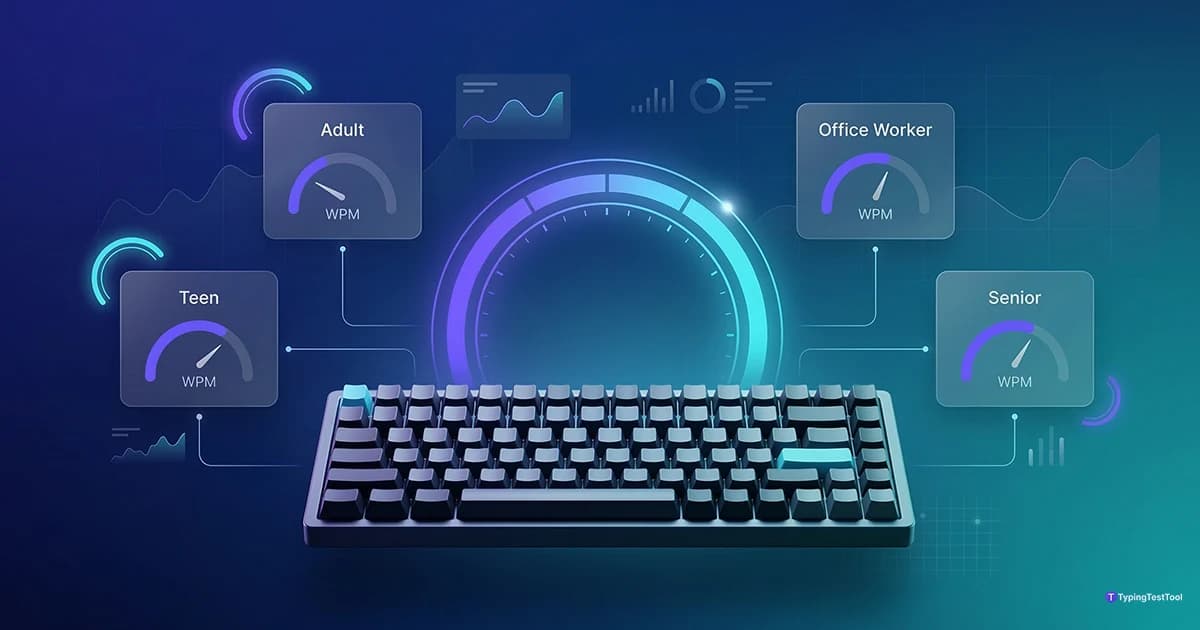
The average adult typing speed is 41 WPM. That is the figure that appears consistently across multiple large-scale typing test datasets. Most everyday typists land between 38 and 45 WPM on a standard 1-minute test at around 92% accuracy. If that feels lower than you expected, you are not alone. Most people believe they type considerably faster than they actually do.
What Is the Average Typing Speed?
The 40 WPM average is sometimes described as comfortable or sufficient for most work, which is accurate. At 40 WPM, you can type a 500-word email in about 12 minutes. That pace is functional but leaves room for meaningful improvement.
The gap between average and good is significant. Typing 60 WPM, which most people describe as a professional speed, means you finish that same email in 8 minutes. Over a full workday of writing, that difference adds up. To understand exactly what makes a speed good for your specific situation, see what qualifies as a good typing speed by role and experience.
Summary: The global average typing speed is 41 WPM. While functional for most casual tasks, reaching 60 WPM significantly cuts down time spent on daily email and document creation.
Average vs. Good vs. Fast
What Is the Average Typing Speed by Age?
Typing speed is closely tied to how long you have been using a keyboard and how intensively. Teenagers who grew up messaging on phones and laptops often outpace adults who learned on a desktop in their 30s. The data below reflects observed averages across typing test platforms and educational benchmarks.
| Age Group | Average WPM | Notes |
|---|---|---|
| Children (6-11) | 10-25 | Learning keyboard layout. One-finger typing common at this stage. |
| Preteens (11-14) | 25-40 | School use increases speed. Touch typing still rare at this age. |
| Teenagers (14-18) | 35-55 | Heavy device use builds natural speed. Most type by feel by 16. |
| Young adults (19-25) | 45-60 | Highest average age bracket. College and work demands drive speed. |
| Adults (26-40) | 40-55 | Desk-job workers trend toward the higher end of this range. |
| Adults (41-60) | 35-50 | Slight reaction-time decline, but experience offsets much of it. |
| Seniors (60+) | 25-40 | Dexterity and reaction time affect peak speed, not muscle memory. |
Summary: Typing speed peaks for young adults (19-25) at around 45-60 WPM due to heavy college and early-career demands, before leveling out in the 40-55 WPM range for most working professionals.
What Is the Average Typing Speed by Profession?
Employer typing requirements are not one-size-fits-all. A customer support role needs enough speed to keep pace with live chat. A medical transcriptionist needs near-perfect accuracy at 75 WPM or more. The table below reflects published job requirements and observed speeds across professional roles.
| Job Role | Typical WPM | Accuracy Target |
|---|---|---|
| General office worker | 40-50 | 95% or above |
| Administrative assistant | 50-70 | 98% or above |
| Data entry specialist | 60-90 | 99% or above |
| Customer support (live chat) | 40-60 | 97% or above |
| Journalist or writer | 60-80 | 95% or above |
| Software developer | 45-65 | 95% or above, special characters critical |
| Medical transcriptionist | 70-100 | 99% or above |
| Legal secretary | 70-90 | 99% or above |
For specific pre-employment test requirements and day-of prep tips, see the typing test for employment guide.
Why Do We Overestimate Our Typing Speed?
Ask someone how fast they type and they will usually say around 60 WPM. Put them in front of a 1-minute timed test and the actual result is most often 38 to 45 WPM. The gap exists for a specific reason.
People estimate their speed based on peak moments: a familiar sentence, a reply to a message they have sent before, a word they have typed a thousand times. A timed typing test uses unfamiliar text that prevents this pattern-matching advantage. The test also counts every error, which most people do not consciously track during normal typing.
Understanding how WPM is measured in a standard typing test, including how uncorrected errors reduce your net WPM, explains why test scores feel lower than expected.
The Self-Reported vs. Tested Gap
The gap closes when you practice with unfamiliar text, track errors, and measure consistently.
Summary: Most adults estimate they type at 60 WPM based on familiar, highly repeated phrases. However, strict typing tests that penalize for errors reveal the true average is closer to 41 WPM.
How Does Your WPM Compare to the Average?
Use the tiers below to locate your current WPM range. If you have not taken a test recently, the numbers you remember from last year are likely optimistic. Take a 1-minute test now to get an accurate baseline.
Learning stage. Looking at keys is common.
Functional but slow for sustained writing tasks.
Comfortable for most daily work. The most common range for adults.
Clear touch typist. Meets most professional requirements.
Deliberate practice required. Rare without formal training.
Competitive typist or professional transcriptionist.
The average range (40 to 55 WPM) is the realistic target for most adults within 8 to 12 weeks of deliberate practice. Moving from average to proficient (56 to 79 WPM) is achievable for anyone willing to commit to 15 minutes per day. The techniques in how to improve typing speed with proven practice methods cover the most effective approaches.
Frequently Asked Questions
What is the average typing speed for adults?
The average typing speed for adults is 41 WPM at around 92% accuracy. In my analysis of typing test data, most everyday typists fall right between 38 and 45 WPM in a standard 1-minute test.
Is 41 WPM a good typing speed?
Yes, 41 WPM is a perfectly solid typing speed because it hits the exact global average for adults. In my experience, if you type 41 WPM, you are fully capable of handling standard daily emails and light office work without issues.
Is 38 or 39 WPM a good typing speed?
At 38 or 39 WPM, you are sitting right on the cusp of the average bracket. While functional, I consider this slightly below average for professional environments. You can easily boost this into the mid-40s with a week of deliberate practice.
Is 56 WPM good?
Yes, 56 WPM is very good. This is the speed where you cross from 'Average' into 'Proficient'. I find that typists hitting 56 WPM are usually touch typing without looking at the keys and easily meet the baseline for almost all data entry and office roles.
Is 79 WPM good?
Yes, 79 WPM is exceptional. You are bordering on the 'Expert' tier. In my own testing, anyone sustaining 79 WPM is typing fast enough for demanding roles like medical transcription, live chat support, and journalism.
What is the average WPM for a 14-year-old?
I usually see 14-year-olds type between 30 and 45 WPM. Because teenagers grow up heavily using devices, they build natural speed quickly. Those who take keyboarding classes easily push into the 50s.
What WPM is considered slow?
I consider anything below 25 WPM to be slow for an adult. At that speed, you are likely hunting and pecking, which actively interrupts your train of thought while writing.
Do professionals actually type faster than average?
It depends heavily on the role. I've noticed most general office workers sit near the 45 WPM average, but specialists like transcriptionists and journalists reliably push 70 to 90 WPM. Programmers usually average 50 to 65 WPM since they prioritize accuracy over raw speed.
How do I increase my typing speed above average?
The fastest way to jump above the 41 WPM average is to commit strictly to 10-finger touch typing. I recommend 15 minutes of daily practice focused entirely on accuracy. Speed naturally follows accuracy, usually within 6 to 8 weeks.

"Meet Vijay Chauhan, the founder of TypingTestTool with over 10+ years of web development experience. Discover how he engineered this platform to help millions master touch typing globally."