
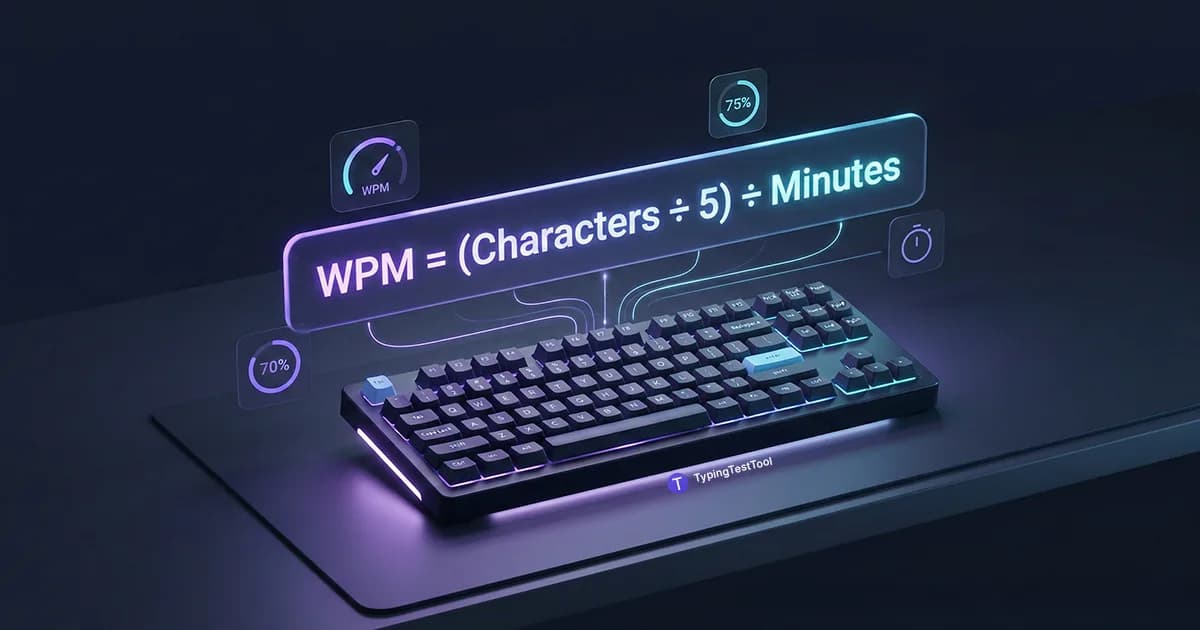
WPM stands for Words Per Minute. The number on your typing test results screen is a standardized measurement, not a direct count of words. Employers in data entry, administration, and customer support all use this same mathematical formula when they set a minimum WPM requirement. Understanding how the calculation works helps you read your score accurately and know exactly what to improve.
Why 5 Characters Equal One Word
The most important thing to know before any formula: a "word" in typing tests is not a dictionary word. It is any group of 5 characters, including spaces, punctuation, and numbers.
The reason for this standard is straightforward. Natural words vary wildly in length. Typing "I" takes one keystroke. Typing "deinstitutionalization" takes 22. If WPM counted actual words, someone typing short common words would always outscore someone typing long technical terms, even if both produced the same volume of text. The 5-character unit levels the playing field.
Shift, Backspace, and other function keys are not counted in the character total. Only the text characters that appear on screen count toward your score.
Quick example
"Hello world!" is 12 characters (including the space and exclamation mark). That counts as 12 ÷ 5 = 2.4 words in a typing test, not 2.
Gross WPM: The Raw Speed Formula
Gross WPM (also called Raw WPM) is a count of every character you typed, divided by 5, divided by the time taken. Errors are not deducted. It tells you purely how fast your fingers moved.
1-Minute Test
(250 chars ÷ 5) ÷ 1
= 50 WPM
3-Minute Test
(900 chars ÷ 5) ÷ 3
= 60 WPM
5-Minute Test
(1750 chars ÷ 5) ÷ 5
= 70 WPM
Gross WPM is useful for tracking raw finger speed, but it does not reflect your usable output. A typist who types 80 WPM and leaves 15 uncorrected errors has not actually produced 80 WPM of usable text. That is where Net WPM comes in.
Net WPM: Why Errors Lower Your Score
Net WPM is the number most employers, certifications, and serious typists care about. It subtracts an error penalty from your Gross WPM to reflect how much correct text you actually produced per minute.
Worked example (2-minute test)
- Characters typed: 800 → Gross WPM = (800 ÷ 5) ÷ 2 = 80 WPM
- Uncorrected errors: 8 over 2 minutes → Error rate = 8 ÷ 2 = 4 errors/min
- Net WPM = 80 − 4 = 76 WPM
Each uncorrected error costs you exactly 1 WPM per minute of the test. Make 5 errors in a 1-minute test and your score drops by 5 WPM. Make 5 errors in a 5-minute test and it only drops by 1 WPM.
Why Only Uncorrected Errors Are Penalized
Most tests only penalize errors you leave in. The reason is straightforward: fixing a mistake already costs you time. The seconds you spend pressing Backspace and retyping naturally reduce your character count and therefore your Gross WPM. Uncorrected errors take a separate deduction because they produce unusable text. If you are preparing to meet typing speed requirements for jobs, you must balance raw speed with error correction.
Corrected error
Time penalty only. The seconds you lost backspacing already slow your WPM naturally. No extra deduction.
Uncorrected error
Costs 1 WPM per minute of test duration. Produces unusable text, so the score penalty reflects the real impact.
How Typing Accuracy Is Calculated
Accuracy is separate from WPM and tells you the percentage of characters you typed correctly out of everything you typed.
If you typed 500 characters and 475 were correct: (475 ÷ 500) × 100 = 95% accuracy
A score of 95% or above is generally considered acceptable for professional use. Anything below 90% means you are producing too many errors to work efficiently, regardless of your WPM. For most office and administrative jobs, employers want at least 97-98% accuracy alongside their WPM requirement.
To understand more about how to raise this number, read our guide on how to increase typing accuracy.
CPM and KPH: The Other Typing Metrics
WPM is not the only way typing speed gets measured. Two other metrics show up regularly, especially in data entry, government testing, and non-English language typing.
| Metric | Full Name | Formula | Common Use |
|---|---|---|---|
| WPM | Words Per Minute | CPM ÷ 5 | Universal standard, English typing tests |
| CPM | Characters Per Minute | WPM × 5 | Non-Latin scripts, precise measurement |
| KPH | Keystrokes Per Hour | CPM × 60 | Data entry jobs, government testing |
| APM | Anschläge Pro Minute | (same as CPM) | Germany, Austria, Switzerland |
For data entry benchmarks: an average professional hits around 10,000-12,000 KPH. Many government and banking data entry roles require a minimum of 8,000 KPH. To convert your WPM to KPH, you can manually multiply by 5 to get CPM, then multiply by 60. A typist with 40 WPM hits approximately 12,000 KPH. You can also use our WPM to KPH calculator to convert your scores instantly.
Try it yourself:
How the math works: We multiply WPM by 5 to get Keystrokes Per Minute (KPM). Then we multiply that result by 60 to calculate your hourly Keystrokes Per Hour (KPH).
How WPM Is Calculated for Other Languages
The 5-character English standard does not always translate cleanly to other writing systems. Each language community has converged on the metric that best reflects real typing effort.
| Language | Primary Metric | Why WPM Differs |
|---|---|---|
| Chinese | CPM (characters/min) | Pinyin input converts multiple Latin keystrokes into one Chinese character. Each character is effectively one selection step. Average: 80-120 CPM. |
| Japanese | CPM (characters/min) | Romaji or Kana input converts to Kanji/Hiragana through IME. Like Chinese, output characters require multiple input events. |
| Korean | KPH or타수 (keystrokes) | Korean tests traditionally count keystrokes (타수, tasu). Hangul syllables form from combining vowel and consonant keystrokes. Average: 300-400 keystrokes/min. |
| German | APM (Anschläge/min) | Germany standardizes on APM (keystrokes per minute), equivalent to CPM. Umlauts (ä, ö, ü) and ß count as single keystrokes. DIN 2103 standard applies. |
| Arabic | WPM (standard) | Standard WPM applies. RTL (right-to-left) writing direction does not change the formula, only the interface layout. |
| Hindi | WPM (standard) | Standard WPM applies, though Kruti Dev and Mangal font users type on different keyboard mappings. The formula stays the same across both. |
| Indonesian | WPM (standard) | Latin script with the same keyboard layout as English. Standard WPM applies without modification. |
Why this matters for your score: If you take a Chinese or Japanese typing test and see a WPM number, check how that test converts. Some multiply characters by 5 to force a WPM equivalent, which can produce scores that look high but do not compare fairly to English WPM benchmarks.
Frequently Asked Questions
What counts as a "word" in a typing test?
A word in a typing test is any group of 5 characters, including spaces and punctuation. Natural word lengths vary too much to use a simple word count, so the 5-character standard makes scores comparable across all typists and all texts.
What is the difference between Gross WPM and Net WPM?
Gross WPM is your raw speed without any error deductions. Net WPM subtracts your error rate (errors per minute) to show your actual productive output. Net WPM is the number employers look at and the one that matters for practical use.
Does fixing my errors during a test penalize my WPM?
No. Most standardized tests only penalize errors you leave uncorrected. If you catch and fix a mistake, the time you spent correcting it already reduced your speed naturally. There is no extra point deduction on corrected errors.
What is CPM and how does it differ from WPM?
CPM is Characters Per Minute. It counts every character you typed in one minute. WPM divides CPM by 5. So 200 CPM equals 40 WPM. CPM gives a more granular view and is more useful for comparing typists working with different word lengths or non-Latin scripts.
What is KPH in typing?
KPH stands for Keystrokes Per Hour. To convert from CPM: multiply by 60. A typist at 40 WPM produces 200 CPM, which is 12,000 KPH. Most data entry jobs require a minimum of 8,000-10,000 KPH.
How is WPM calculated for Chinese typing?
Chinese typing is measured in Characters Per Minute (CPM or CCPM) rather than WPM. Pinyin input requires multiple Latin keystrokes to produce one Chinese character, so the standard 5-character WPM formula does not translate directly. The more meaningful metric is characters per minute.
Is 40 WPM a good typing speed?
40 WPM is the average adult typing speed and is fine for everyday use. Office and administrative jobs usually ask for 50-65 WPM. Data entry and court transcription roles typically require 75-100 WPM. Competitive typists regularly reach 120-150 WPM.
How can I improve my WPM score?
Improve accuracy first, not speed. More errors lower your Net WPM even if your raw fingers move faster. Practice for 15-20 minutes daily using proper home row hand position and without looking at the keyboard. Most typists see consistent gains within 4-6 weeks of daily practice. Our guide on how to improve typing speed covers this in detail.

"Meet Vijay Chauhan, the founder of TypingTestTool with over 10+ years of web development experience. Discover how he engineered this platform to help millions master touch typing globally."