
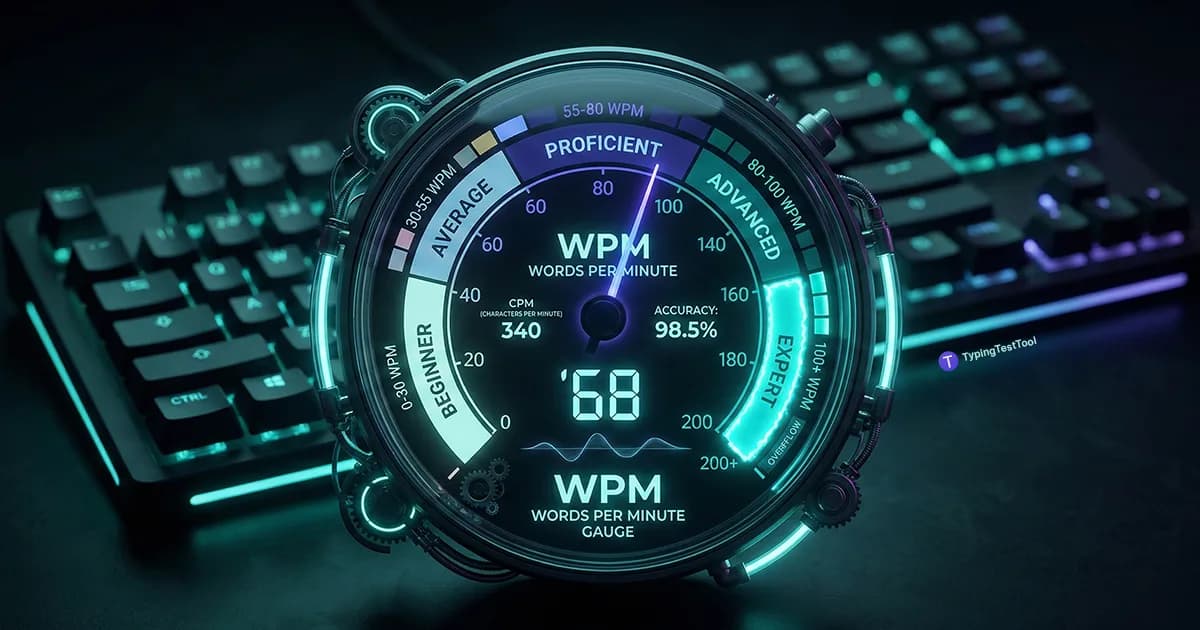
The average adult types around 40 words per minute. Whether that is "good" depends entirely on what you need it for. A 40 WPM typist applying for a legal transcription role in the US or UK will not pass the test, whereas the same person writing emails will never notice a problem. I've broken down the exact typing speed benchmarks by job role, age group, and country so you can set a realistic goal.
What Are the 5 Typing Speed Tiers?
Different speeds unlock different capabilities. Here is what each tier actually means in the real world.
| Level | WPM Range | Who is typically here |
|---|---|---|
| Beginner | Under 25 WPM | New typists, young children, hunt-and-peck users |
| Average | 25-50 WPM | Most adults, general computer users |
| Proficient | 51-70 WPM | Office workers, regular keyboard users, most job applicants |
| Advanced | 71-100 WPM | Journalists, programmers, executive assistants, power users |
| Expert | 100+ WPM | Touch typists, competitive typists, transcriptionists |
Moving from Beginner to Average mostly requires repetition. Moving from Average to Proficient requires learning proper technique (10-finger touch typing). Moving from Proficient to Advanced requires deliberate daily practice with focused drills. Above 100 WPM, raw finger speed and muscle memory are the limiting factors.
Summary: There are 5 main typing speed tiers ranging from Beginner (under 25 WPM) to Expert (100+ WPM). Most adults fall into the Average tier, while professional typing roles usually require Proficient to Advanced speeds.
What Is a Good WPM for Your Job Role?
Employers in the US, UK, Australia, and Canada set different WPM thresholds depending on how central typing is to the role. I pulled these baseline requirements from typical job boards and HR assessments.
| Job Role | Min WPM | Preferred WPM | Accuracy |
|---|---|---|---|
| General office / admin | 40 WPM | 55 WPM | 95% |
| Customer service / support | 50 WPM | 65 WPM | 96% |
| Data entry operator | 45 WPM | 65 WPM | 97% |
| Secretary / executive assistant | 55 WPM | 75 WPM | 97% |
| Legal / court transcription | 80 WPM | 100+ WPM | 99% |
| Medical transcription | 65 WPM | 90 WPM | 99% |
| Journalist / copywriter | 65 WPM | 90 WPM | 95% |
| Software developer | No standard | 50-70 WPM typical | Variable |
Accuracy matters as much as speed
A data entry operator typing 65 WPM at 90% accuracy produces a Net WPM of roughly 58.5. That is below the minimum requirement for most roles, even though the raw speed looks acceptable. Employers treat accuracy as a hard cutoff, regardless of your raw speed.
Summary: Different jobs require different typing speeds. General office work expects 40-55 WPM, data entry operators need 45-65 WPM, and highly demanding roles like legal transcription require 80-100+ WPM with near-perfect accuracy.
What Are the Government Job WPM Requirements by Country?
Government and civil service typing tests are often more specific about minimum scores than private sector jobs. These are the documented benchmarks for Tier 1 English-speaking countries.
| Country | Role Type | Min WPM | Accuracy |
|---|---|---|---|
| United States | Federal clerical / typist positions | 35-40 WPM | 95% |
| United States | Government data entry roles | 60 WPM | 97% |
| United Kingdom | Civil service admin roles | 50-60 WPM | 95% |
| United Kingdom | Legal / transcription government roles | 70+ WPM | 98% |
| Australia | Government admin (AS2708-2001 standard) | 40-60 WPM | 95-98% |
| Australia | Police support staff | 25 WPM | 98% |
| Canada | Federal administrative officer | 40-50 WPM | 95% |
Australia uses the AS2708-2001 standard for evaluating keyboarding proficiency across government and public sector employment. If you are applying for an Australian Public Service role, that standard defines what counts as a pass.
Summary: Government typing requirements vary by country. US federal roles expect 35-60 WPM, the UK civil service requires 50-70+ WPM, and Australian government jobs benchmark at 40-60 WPM.
What Is the Average Typing Speed by Age?
Typing speed peaks in the 19-30 age range for most people. This happens because 20-somethings combine peak motor skills with heavy daily keyboard use from school or early career jobs.
| Age Group | Average WPM | Context |
|---|---|---|
| Children (6-10) | 5-20 WPM | Learning keyboard layout, mostly hunt-and-peck |
| Pre-teens (11-13) | 20-35 WPM | Keyboard use increasing with school assignments |
| Teenagers (14-18) | 35-50 WPM | Academic writing, messaging, social media use |
| Young adults (19-30) | 45-70 WPM | Peak speed range. High keyboard hours from work and study |
| Adults (31-50) | 40-60 WPM | Speed stabilizes. Accuracy often improves with experience |
| Adults (51-60) | 35-55 WPM | Slight decline in raw speed, but accuracy stays high |
| Seniors (60+) | 25-45 WPM | Raw speed declines but accuracy often exceeds younger typists |
Accuracy tends to improve with age even as raw speed declines. A 58-year-old typing at 40 WPM with 99% accuracy is producing more usable text per minute than a 22-year-old typing at 55 WPM with 88% accuracy.
Speed vs. Accuracy: Which Matters More?
In practice, Net WPM is the only number that matters because it subtracts your errors from your gross speed, and that is what employers look at when they test you.
Typist A
Gross WPM: 80 WPM
Accuracy: 85%
Errors per minute: ~12
Net WPM: ~68 WPM
Produces 15% unusable text. Fails most employer accuracy requirements.
Typist B
Gross WPM: 60 WPM
Accuracy: 98%
Errors per minute: ~1
Net WPM: ~59 WPM
Produces nearly all usable text. Meets professional accuracy requirements.
Typist B is slower but produces far more usable output. For any role where accuracy matters (which is nearly all of them), focusing on error reduction before chasing speed is the correct priority. Read our guide on how to increase typing accuracy if your error rate is holding your Net WPM down.
How Long Does It Take to Improve?
These are realistic timelines for typists who practice 15-20 minutes per day with deliberate focus, not casual typing. Casual typing at work does not improve speed meaningfully because it reinforces existing habits rather than building new ones.
Under 20 WPM to 40 WPM
4-8 weeks
20-40 WPM to 60 WPM
8-16 weeks
40-60 WPM to 80 WPM
16-26 weeks
60-80 WPM to 100 WPM
6-12 months
These assume 15-20 minutes of focused practice daily using proper 10-finger touch typing. Progress above 80 WPM slows significantly and depends heavily on technique consistency.
The plateau between 60 and 80 WPM is where most adult learners stall. At this level, the technique is mostly learned but muscle memory is not yet automatic. Pushing through requires deliberate repetition of weak keys and difficult letter combinations rather than general practice. Read our guide on how to improve typing speed for practical methods that work at each tier.
What Are the Typing Speed World Records?
It helps to know the absolute human limit just for perspective.
- 305 WPM: MythicalRocket, unofficial record on TypeRacer (short burst, single sentence)
- 256 WPM: Sean Wrona, sustained speed over a longer test session
- 212 WPM peak / 170 WPM sustained: Barbara Blackburn on Dvorak layout, Guinness-verified from 1976 to 1986
These speeds are achieved using non-standard conditions: short texts, optimal word selection, and in some cases non-QWERTY keyboards (Dvorak). Most professional typists in demanding roles (court transcriptionists, journalists) plateau at 80-120 WPM over a full working session. Anything above 150 WPM is exceptional by any standard.
For context, the difference between 60 WPM and 100 WPM in daily work output is significant. The difference between 100 WPM and 200 WPM in most jobs is almost unnoticeable, because output is limited by reading, thinking, and decision-making, not finger speed.
Summary: The absolute human limit for typing is around 250-300 WPM in short bursts, but even world-class typists plateau at 80-120 WPM for sustained working sessions.
Frequently Asked Questions
Is 40 WPM a good typing speed?
Yes, 40 WPM is perfectly fine for general use since it's the average adult speed. However, in my experience reviewing job requirements, most office and administrative employers expect 50-60 WPM at minimum. If your goal is employment, 40 WPM will usually land you below the threshold.
Is 50 WPM a good typing speed?
Yes, 50 WPM is a solid, above-average typing speed. In my experience, hitting 50 WPM means you are fully competent for general office work, though you might fall slightly short of the requirements for specialized typing roles.
What is a good WPM for a data entry job?
I typically see data entry positions require 45-65 WPM with 97% or higher accuracy. In demanding fields like finance and healthcare, I've noticed they often ask for 75-100 WPM because errors cause costly downstream corrections. From what I've seen, accuracy matters just as much as speed in these roles.
Is 60 WPM fast enough for office work?
Yes. 60 WPM at 95% or higher accuracy is considered highly proficient for most office and administrative roles. I find that at this speed, you can produce roughly 2,400 words per hour, which easily covers all typical document creation and email tasks.
Is 65 WPM good?
Yes, 65 WPM is very good and puts you firmly in the 'Proficient' category. I find that at 65 WPM, you are fast enough to qualify for almost all data entry, customer service, and standard transcription jobs without breaking a sweat.
Is 80 WPM good?
Yes, 80 WPM is excellent and borders on the 'Advanced' tier. If you can type 80 WPM with high accuracy, I consider you highly qualified for demanding roles like legal or medical transcription. At this speed, you are typing almost as fast as most people think.
What WPM do most employers require?
It depends entirely on the role, but here is what I usually see: General office work expects 40-60 WPM. Customer service roles want 50-65 WPM. For legal and medical transcription, I've seen employers demand 80-100 WPM with near-perfect accuracy. Government jobs have their own specific standards, usually hovering between 40-60 WPM.
What is a good typing speed for a student?
For a student, 50-60 WPM is an excellent target because it removes typing as a bottleneck in essays and note-taking. I usually see high school students average 35-50 WPM, but if you can push that to 60-80 WPM, I guarantee you'll notice a massive boost in your academic productivity.
Is 100 WPM considered fast?
Yes! 100 WPM puts you in roughly the top 5% of all typists. In my own typing journey, I found that at this speed, your fingers are no longer the limiting factor in any professional role. Keep in mind, almost everyone I know who reaches 100 WPM has been using proper 10-finger touch typing consistently for several years.
How do I know if my accuracy is good enough?
For general use, 95% is acceptable, but for professional roles, 97% or above is the standard. I always recommend a simple practical check: if your Net WPM is more than 10% lower than your Gross WPM, you need to focus on accuracy before speed. I highly suggest understanding how WPM is calculated so you can properly read your test results.
How can I check my typing speed for free?
You can take a free typing test right here on TypingTestTool! I designed the test to show your Gross WPM, Net WPM, and accuracy. I've also made tests available in 1-minute, 3-minute, and 5-minute durations so you can benchmark yourself exactly how you need to.

"Meet Vijay Chauhan, the founder of TypingTestTool with over 10+ years of web development experience. Discover how he engineered this platform to help millions master touch typing globally."